Key Results
- MOS: 4067 Computer Programmer, United States Marine Corps
- First language: Ada, learned at MOS school at the Marine Corps Air Ground Combat Center, Twentynine Palms, California
- Foundations, including SQL: Visual Basic, HTML, JavaScript, SQL, Lotus Notes and Microsoft Access at the same school
- Advanced database training: sent back to 29 Palms several times for Oracle and Microsoft SQL Server DBA training
Summary: Learning to Code in the Marine Corps
Every developer has a first language. Mine was Ada, and I learned it in the middle of the Mojave Desert. I was 19 when I started coding. After boot camp at Parris Island and recruiter's assistance duty, the Marine Corps sent me to MOS school. It was for the 4067 Computer Programmer specialty at the Marine Corps Air Ground Combat Center in Twentynine Palms, California. There I learned Ada, then Visual Basic, HTML, JavaScript, SQL, Lotus Notes and Microsoft Access.
From there I was stationed at Camp Lejeune, North Carolina, with the 2nd Force Service Support Group. The Marine Corps sent me back to Twentynine Palms several times for advanced database training as a database administrator on Oracle and Microsoft SQL Server. That training became the foundation for everything I built as a Marine, and for the web development and app development work I lead today.
About the Place: Twentynine Palms
The Marine Corps Air Ground Combat Center, known simply as 29 Palms, sits on the southern edge of the Mojave Desert. The Navy describes it as lying "on the southern boundary of the Mojave Desert," about 140 miles east of Los Angeles.
Its history starts before the Marines. The base's own 60th anniversary history explains that in November 1941 the Army Air Corps set up a glider training school on dry lake beds north of town, later known as Condor Field. In 1952, Camp Pendleton's Post Order 343 "made 930 square miles of the Mojave Desert into Camp Detachment Marine Corps Training Center." In February 1957 it became an independent command, Marine Corps Base Twentynine Palms, and in February 1979 it took its present name, the Marine Corps Air Ground Combat Center.
It is known as the Marine Corps' largest training base. Marine Corps Installations West calls it "the site of final training for all deploying Marine Combat units." It is also where the Marine Corps trained its computer programmers, which is how I ended up writing code in the desert.
About the School: MOS 4067 at MCCES
In the Marine Corps, MOS stands for Military Occupational Specialty, the job code that defines what a Marine is trained to do. Mine was 4067. The Marine Corps MOS Manual lists it as "MOS 4067, Programmer, ADA." That 2005 edition of the manual, published after my service, notes that all MOSs in Occupational Field 40 were deleted "with the exception of MOS 4067, Programmer, ADA," which shows how long the Ada programmer specialty lasted.
The training happened at the Marine Corps Communication-Electronics School, known as MCCES or simply C and E, aboard the Combat Center. A school listing of that period shows "4067 PROGRAMMER ADA CO MCCES TWENTYNINE PALMS CA." The school has deep roots. According to a Combat Center history published on DVIDS, it began as a Signal School at Quantico in 1912, was redesignated the Communication-Electronics School Battalion in 1953, and took the name Marine Corps Communication-Electronics School in 1971. The Combat Center's 60th anniversary publication explains that Headquarters Marine Corps moved its "fastest-growing school" to the desert partly because "the remote location meant less atmospheric interference and noise interruption from airport takeoffs and landings."
The Challenge: Why Ada?
Today Ada sounds like an unusual first language. In the Department of Defense it was the standard. DoD Directive 3405.1, issued April 2, 1987, declared that "The Ada programming language shall be the single, common, computer programming language for Defense computer resources used in intelligence systems, for the command and control of military forces, or as an integral part of a weapon system." The same directive said Ada "shall be used for all other applications, except when the use of another approved higher order language is more cost-effective."
The goal, according to the National Academies' review Ada and Beyond, was to bring order to a defense software world that used many different languages.
In April 1997, Assistant Secretary of Defense Emmett Paige signed a memo to eliminate "the mandatory requirement for use of the Ada programming language in favor of an engineering approach to selection of the language to be used." When I started training in 1999, Ada was still the first language the 4067 school taught me. It was a strict, strongly typed language that forced you to be precise, which turned out to be exactly the discipline I needed.
The Training
Ada: learning to think like a programmer
Ada was my introduction to programming. It taught me structure, types and the habit of writing code that does exactly what you intend. Those habits never left.
ColdFusion: my first scripting language
ColdFusion became my first scripting language in the Marines. It was how I first built database driven web applications, and it was the original platform behind Small Unit Logistics.
The .NET Framework at launch
When Microsoft's .NET Framework 1.0 launched in 2002, I learned it right away. Microsoft's own .NET team marks it as "the first version of .NET", released as part of Visual Studio .NET. I helped adapt existing Classic ASP and ColdFusion systems onto .NET, using ASP.NET and C#, including the ColdFusion to .NET migration of SUL.
Advanced database training: Oracle and SQL Server DBA
After MOS school I was stationed at Camp Lejeune with the 2nd Force Service Support Group.
About the 2nd Force Service Support Group
The 2nd Force Service Support Group was the logistics backbone of II Marine Expeditionary Force, headquartered at Camp Lejeune, North Carolina. Its lineage goes back to 1944. According to the official 2nd Marine Logistics Group history the unit relocated to Camp Lejeune in September 1945 and was "Redesignated 30 June 1978 as 2d Force Service Support Group." In Operation Iraqi Freedom, the 2d FSSG formed the Marine Logistics Command. The Marine Corps History Division account of combat service support in OIF explains that "2d FSSG or MLC was the wholesale level logistics organization," responsible for brokering sustainment such as ammunition, fuel and water and pushing it out across the battlefield. In 2005 the Marine Corps renamed every FSSG a Marine Logistics Group. The command I was stationed with, and whose in garrison website I helped build and maintain, became today's 2nd Marine Logistics Group.
Why the desert: combined arms at a scale nowhere else can match
Twentynine Palms was a fitting place to learn to build systems for the whole Marine Corps. The Combat Center's official overview calls it "the premier service level, live fire and maneuver training base in the Marine Corps," covering 1,102 square miles, "roughly the size of Rhode Island." It explains that the Mojave terrain is "the perfect venue for the realistic, combined arms training" Marines need. Units fight as a Marine Air Ground Task Force, "bringing together under one commander the ground, air and logistics elements needed to ensure mission success." On October 1, 2000, the command was designated the Marine Air Ground Task Force Training Command.
That last word, logistics, is where my career went. Everything I learned at C and E ended up supporting the logistics element at Camp Lejeune and, in 2003, in the war in Iraq, where the Gas, Gas, Gas alert and Small Unit Logistics put that training to the test.
The Marine Corps sent me back to Twentynine Palms several times for advanced database training, including database administrator training on Oracle and on Microsoft SQL Server. That training paid off directly.
My Marine Corps Timeline
- 1999 Joined the Marine Corps through the Delayed Entry Program before shipping to boot camp
- August 16, 1999 Entered active duty; boot camp at Marine Corps Recruit Depot Parris Island, then recruiter's assistance duty
- 1999 MOS 4067 Computer Programmer school at MCCES, Marine Corps Air Ground Combat Center, Twentynine Palms
- 2000 Entry Level ADA Programming course
- MOS school Ada, my first language, then Visual Basic, HTML, JavaScript, SQL, Lotus Notes and Microsoft Access
- Early 2000s ColdFusion, my first scripting language in the Marines, then Classic ASP
- 2002 Database Management System course
- 2002 Learned the .NET Framework when it launched in 2002 and used it to adapt Classic ASP and ColdFusion systems
- Early 2000s Stationed at Camp Lejeune, North Carolina, with the 2nd Force Service Support Group, with several trips back to Twentynine Palms for advanced Oracle and Microsoft SQL Server DBA training
- 2003 Deployed for Operation Iraqi Freedom with Small Unit Logistics
- August 15, 2003 Honorably released from active duty as a Sergeant (E5) at Camp Lejeune, after 3 years and 5 months in MOS 4067
My DD-214 shows active service from August 16, 1999, to August 15, 2003. I was meritoriously promoted at every promotion cycle and scored a perfect 300 on most of my Marine Corps physical fitness tests, the maximum possible score.
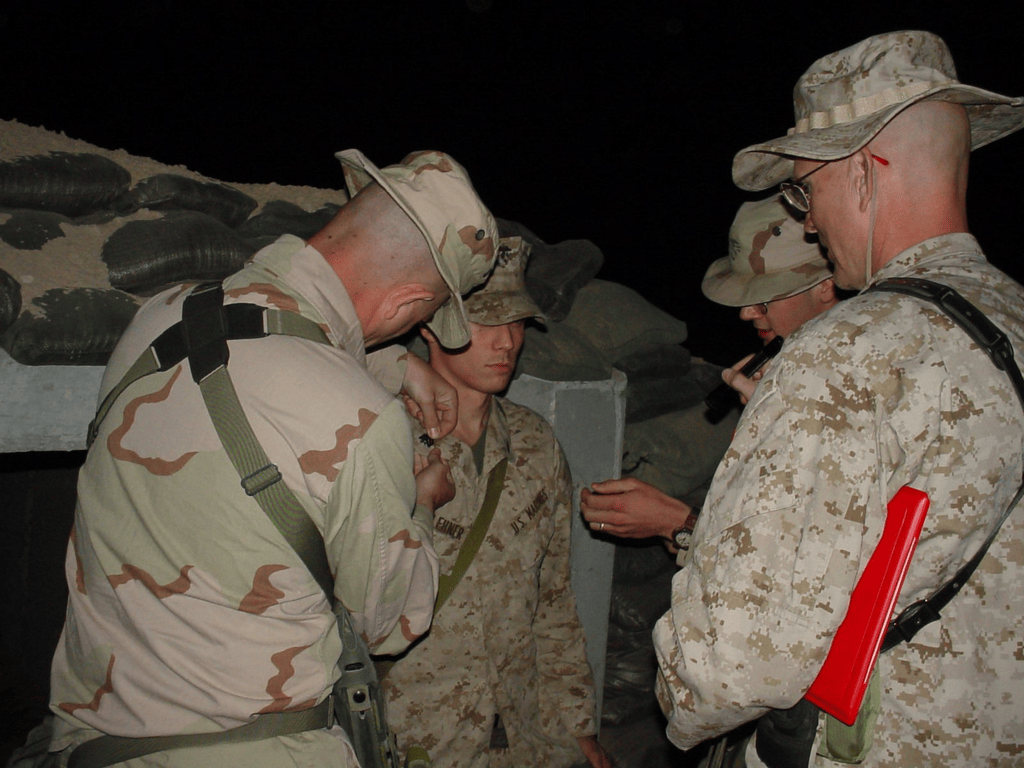
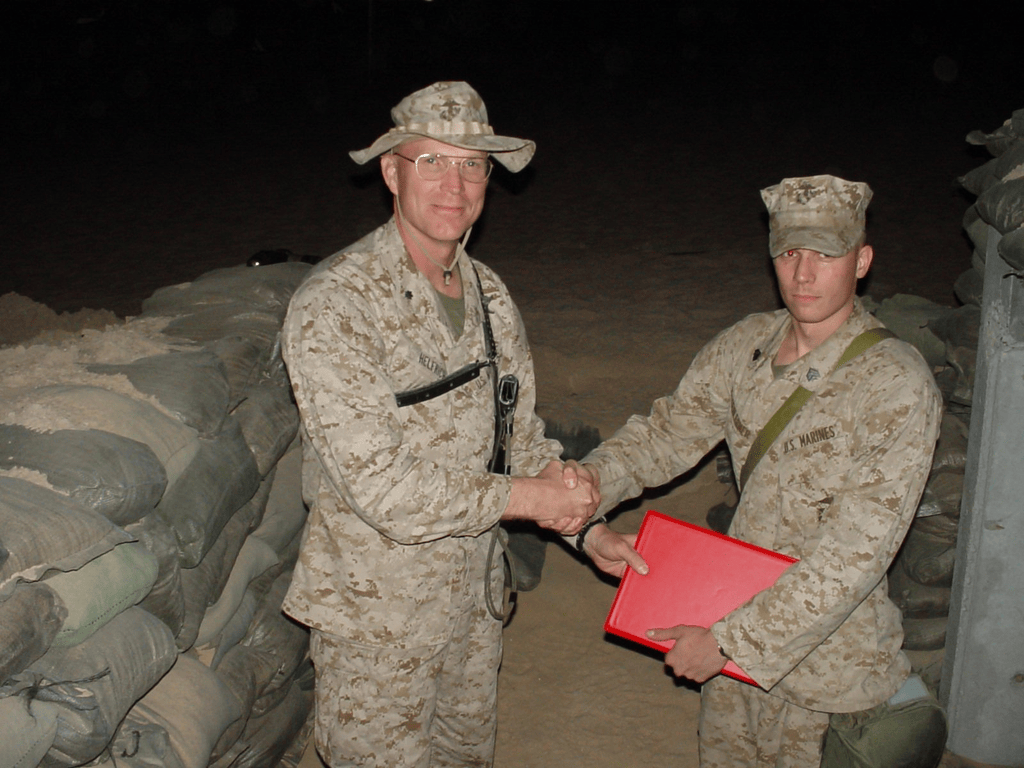
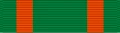
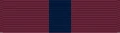
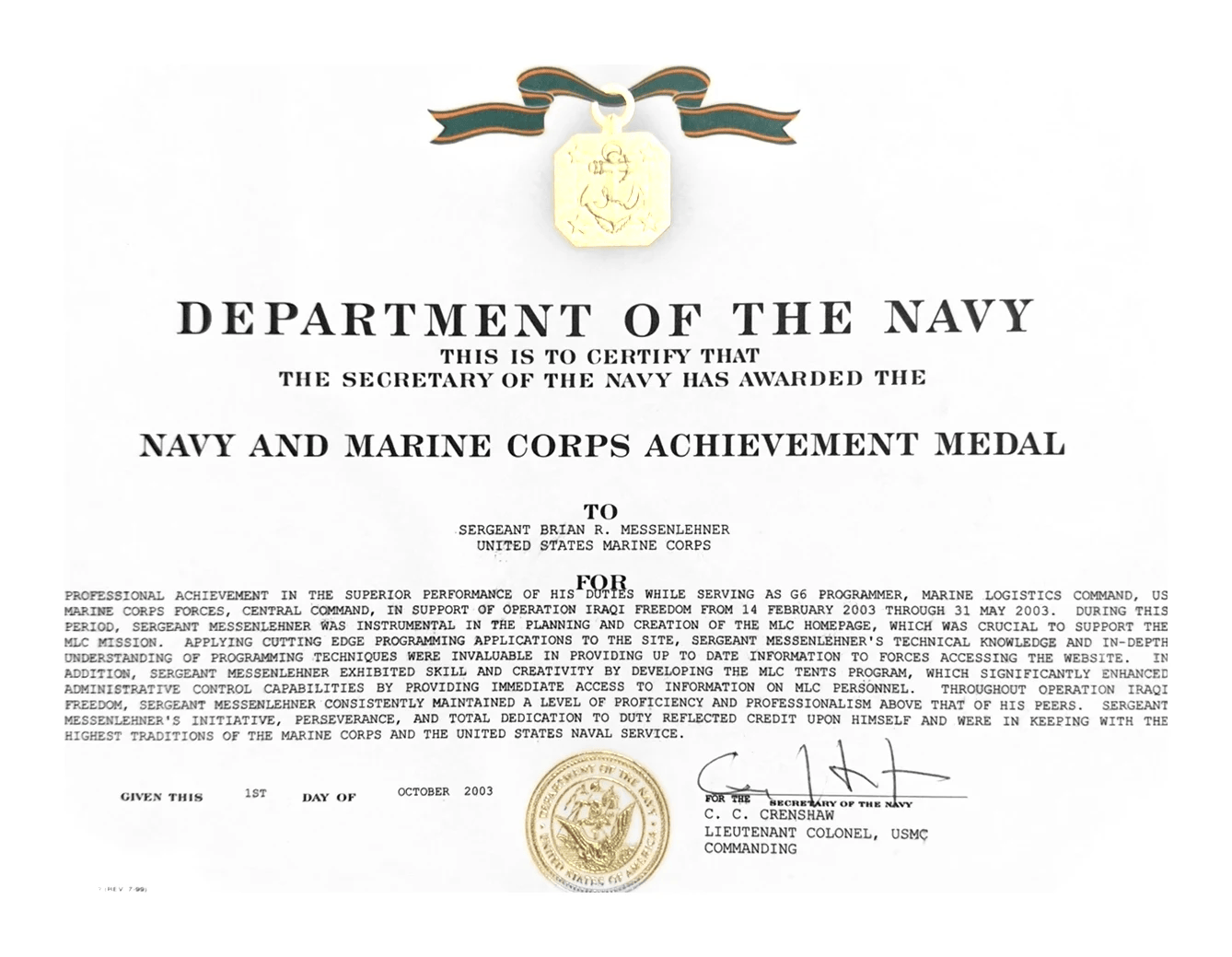
My decorations include the Navy and Marine Corps Achievement Medal, Marine Corps Good Conduct Medal, Sea Service Deployment Ribbon, National Defense Service Medal, Rifle Expert Badge and Pistol Expert Badge.


The Technologies the Marine Corps Taught Me
At MOS school, Twentynine Palms
- Ada: my first programming language, a strict, strongly typed language built for defense software.
- Visual Basic: Microsoft's language for building Windows applications quickly.
- HTML: the markup behind every web page, my first step into web development.
- JavaScript: the language that makes web pages interactive.
- SQL: structured query language, how you ask a relational database for exactly the data you need. Twentynine Palms is where I learned SQL, and I am still very good at it today. It sits under every WordPress site, every migration and every app we build.
- Lotus Notes: a collaboration, email and database platform many organizations ran at the time.
- Microsoft Access: Microsoft's desktop relational database, great for learning data design.
During my Marine service
- ColdFusion: my first scripting language in the Marines, for building database driven web applications. The original platform behind SUL.
- Classic ASP: Microsoft's server side scripting for the web, used across many systems I built and maintained.
- .NET Framework: learned when it launched in 2002, with ASP.NET and C#, and used to adapt Classic ASP and ColdFusion systems.
On DBA training trips back to Twentynine Palms
- Oracle: enterprise relational database and the backbone of Small Unit Logistics.
- Microsoft SQL Server: Microsoft's enterprise database, trained as a database administrator.
Results: Where the Training Went
The Oracle training was the backbone of Small Unit Logistics (SUL), where I migrated the front end from ColdFusion to .NET on the same Oracle database and wrote the scripts that imported mainframe equipment data into Oracle. The relational database design I learned shaped the Camp Lejeune Armory Management System, with its one to one and one to many relationships between weapons and Marines, and the Tent Management system I built for deployed tent cities. HTML, JavaScript and server side skills went into the 2nd FSSG in garrison website. Across that work I used ColdFusion, Classic ASP, ASP.NET, C#, PHP, SQL Server and Oracle.
What It Taught Me
Start strict. Ada forced precision. That discipline still shows up in how we review code, plan data models and test every site at five screen sizes before launch.
Databases are the foundation. SQL from Twentynine Palms is still one of my strongest skills. Learning to administer Oracle and SQL Server taught me that applications come and go, but data lasts. It is why every platform migration to WordPress we lead starts with the data.
Keep learning. The Marine Corps kept sending me back for more training. I went from Ada to Visual Basic, Lotus Notes, Access, ColdFusion, Classic ASP, .NET, PHP and WordPress, and today to mobile apps and AI. The tools change; the habit of learning does not.
Training is an investment. The Marine Corps invested in me, and it paid off in the field. We invest the same way in our team and in the clients we train to run their own WordPress sites and apps.
Frequently Asked Questions
What is the 4067 MOS in the Marine Corps?
MOS means Military Occupational Specialty. 4067 was the Computer Programmer specialty, listed in the MOS Manual as "Programmer, ADA," and taught at MCCES in Twentynine Palms. As a 4067, I built and maintained web applications and relational databases.
Why did the military teach Ada?
DoD Directive 3405.1 of 1987 made Ada the single, common programming language for intelligence, command and control and weapon system software, and the preferred language for other applications. The mandate was removed in 1997, but Ada was still the first language I was taught in 1999.
Where is Twentynine Palms?
The Marine Corps Air Ground Combat Center is in the southern Mojave Desert in San Bernardino County, California, about 140 miles east of Los Angeles.
What database training did Brian receive?
After MOS school, I returned to Twentynine Palms several times for advanced database training, including Oracle and Microsoft SQL Server DBA training.
Related Military Case Studies
- Small Unit Logistics: A ColdFusion to .NET Migration for the Marine Corps
- Armory Management System for Camp Lejeune: Custom Asset Tracking
- Tent Management: A Personnel Tracking System for Deployed Marines
- 2nd FSSG: Building the In Garrison Website at Camp Lejeune
- Marine Corps 4067 Computer Programmer: Learning Ada and Databases at 29 Palms
- Gas, Gas, Gas: The Network Emergency Alert I Built During Operation Iraqi Freedom
Projects from this period
- 2nd FSSG: Building the In Garrison Website at Camp Lejeune
- Armory Management System for Camp Lejeune: Custom Asset Tracking
- Small Unit Logistics: A ColdFusion to .NET Migration for the Marine Corps
- Gas, Gas, Gas: The Network Emergency Alert I Built During Operation Iraqi Freedom
- Tent Management: A Personnel Tracking System for Deployed Marines
- The MLC Homepage: A Command Website on SIPRNet in Operation Iraqi Freedom
In My Words
Learning Ada as my first language in the middle of the Mojave Desert at Twentynine Palms gave me habits of structure and precision that I still lean on every time I write code.
Brian Messenlehner
Project leadership by Brian Messenlehner.
Build on a Strong Foundation
From Ada in the Mojave Desert to WordPress platforms and mobile apps today, we bring disciplined engineering to every web development, app development and platform migration project. Tell us about yours.
Brief Us on Your Mission
Want to talk about a website, mobile app, migration or AI project? Fill out the Mission Brief and a specialist will follow up to schedule a call and put together a free quote.
Related: Brian Messenlehner bio, WordPress for government and military.