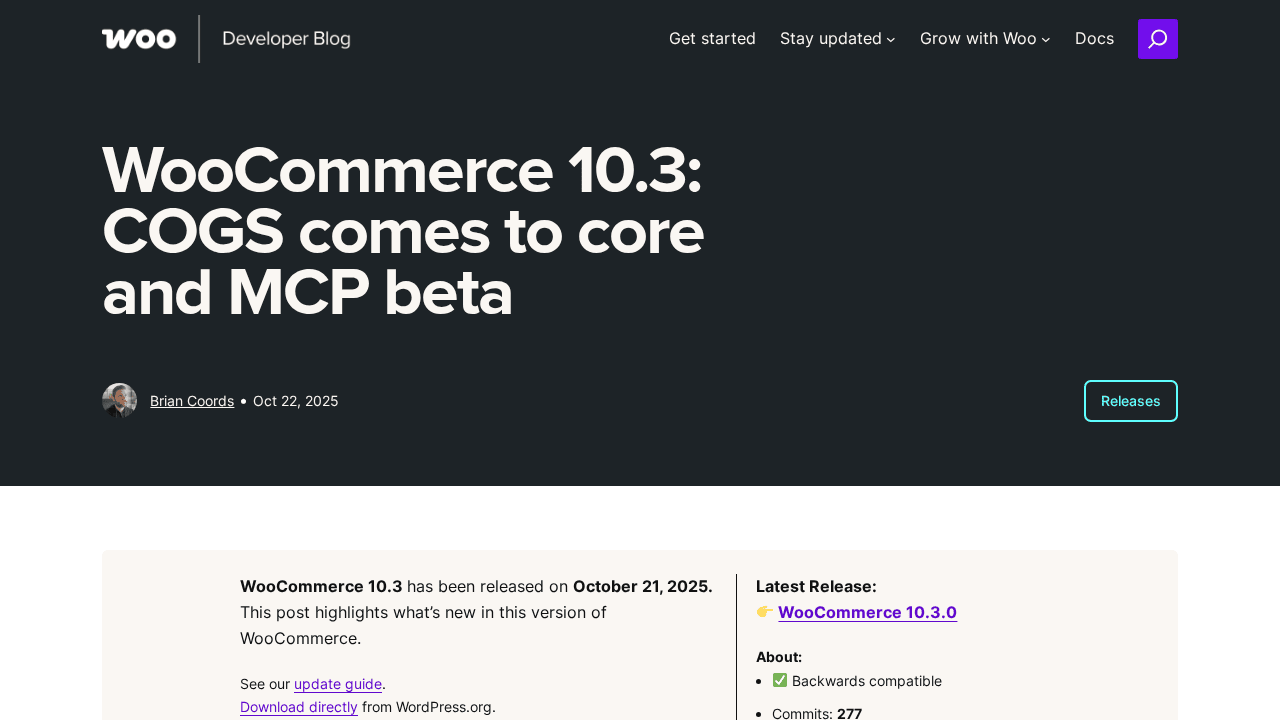
WooCommerce 10.3 was released on October 22, 2025. It moves Cost of Goods Sold out of the experimental features list, opens a beta of the WooCommerce MCP integration, adds address autocomplete to both checkout types and upgrades the built in PayPal integration to the PayPal Orders v2 API.
The release lists 277 commits from 54 contributors, includes a database update and still requires WordPress 6.7 and PHP 7.4. Three quick fix releases, 10.3.1 through 10.3.3, followed on October 23 and 24, 2025, and they are covered near the end of this post.
Cost of Goods Sold leaves the experimental list in 10.3
Cost of Goods Sold (COGS) is now a standard WooCommerce feature. Store owners can enter what each product costs them, and WooCommerce uses that figure to calculate profit margins at the product and order level. The feature also adds admin screens plus REST API and programmatic API changes, so reporting tools and custom dashboards can read cost data through documented APIs. COGS is switched on in the store settings.
Margins you can trust. Profit reporting is only as good as the cost data behind it. Before a client turns COGS on, we check whether an inventory, accounting or reporting extension already stores product costs, so the store does not end up with two competing numbers. We then load costs on staging, compare a sample of order level margins against the client's own spreadsheet and only enable the feature in production once those totals agree.
WooCommerce MCP opens as a beta
WooCommerce 10.3 ships an early, beta version of a Model Context Protocol (MCP) integration. MCP is an open standard that lets AI applications connect to outside data and tools. WooCommerce exposes store operations as discoverable tools that MCP compatible clients, such as Claude, Cursor or VS Code, can use with proper authentication and permissions.
AI tools and store data. An MCP connection can read and change real store data, so we treat it like any other API key. If a client wants to experiment, we set it up on a staging copy first, give the connecting account the narrowest permissions that still work and keep production out of reach until the client has seen exactly which actions the AI client can take.
Address autocomplete reaches block and shortcode checkout
Shoppers can start typing an address and choose from suggested matches in both the Checkout block and the shortcode checkout. WooCommerce built this on a provider architecture, so developers can plug in an address validation service of their choice. WooPayments merchants in good standing were offered a switch under WooCommerce, Settings, General, although WooCommerce later noted that address autocomplete for WooPayments was temporarily disabled while performance improvements roll out.
Cleaner shipping addresses. Fewer typos at checkout means fewer returned parcels and fewer support emails. When a store adds autocomplete, we place test orders with apartment numbers, rural routes and international addresses on staging, confirm that shipping rates and tax still calculate from the selected address, and check that any custom checkout fields still sit where the client expects them.
PayPal Orders v2 and Express Checkout buttons
The PayPal integration bundled with WooCommerce now uses the PayPal Orders v2 API. It also adds Express Checkout buttons for PayPal, Venmo and Pay Later where those options are available.
PayPal on stores we manage. Payment changes are the one area where we never rely on a quick look. On stores that use the bundled PayPal option, we run sandbox purchases with each available button, issue a test refund, and confirm that the order status, emails and stock levels update correctly before the change reaches customers.
Blocks and the Product Collection editor in 10.3
- Choosing a variation in the Add to Cart + Options block (beta) now updates related product blocks, for example scrolling the Product Gallery to the variation image or hiding Product Quantity for items sold individually
- Product Collection editing makes fewer product requests and no longer reports "ghost changes" that prompt a save when nothing changed
- A new
/wc/v3/variationsREST endpoint was added, and private or draft product names are no longer returned where they should not be
Script handles, sessions and coupons: developer notes for 10.3
- Script handles registered in
WC_Admin_Assetsnow carry WooCommerce prefixes, for exampleaccountingbecomeswc-accounting - An opt in experimental feature clears empty customer sessions so guest pages can be cached more effectively
- A coupon recalculation change that caused unwanted discount recalculations when editing orders was reverted
- WooCommerce announced a two week delay for 10.4 to move that release away from Black Friday and Cyber Monday
Extensions that load old script names. Prefixed script handles are the change most likely to break an older theme or extension quietly. We search client code for the unprefixed handles, load the admin and storefront with the browser console open on staging, and patch any custom plugin to register its own dependencies instead of assuming WooCommerce loads them.
Order data and PayPal fixes in 10.3.1 to 10.3.3
WooCommerce 10.3.3 was released on October 24, 2025, after 10.3.1 and 10.3.2 on October 23. The fixes include a race condition that could delete processing or completed orders during cart cleanup, PayPal order failures caused by an AMOUNT_MISMATCH error when fees were present, a check so PayPal capture only runs on PayPal orders, and backwards compatibility with deprecation warnings for extensions that still enqueue unprefixed script handles.
Why the order deletion fix matters. A bug that can remove paid orders is the kind of issue we move to the front of the queue. For stores on our plans, we confirm the store is running 10.3.3 or later, then compare recent order counts against payment gateway records to make sure nothing went missing during the window when 10.3.0 was installed.
WooCommerce 10.3 questions
Do I have to use Cost of Goods Sold?
No. COGS is a standard feature in 10.3, but a store only starts tracking costs once it is enabled in the settings.
Is the MCP integration ready for production stores?
WooCommerce describes it as a beta that is ready for broader testing, so it is best tried on a staging site first.
Did WooCommerce 10.3 change the minimum WordPress version?
No. WooCommerce 10.3 requires WordPress 6.7 or newer and PHP 7.4 or newer, the same as 10.2.
Running a store on WooCommerce 10.3? Our support and maintenance plans include staged plugin updates, checkout and payment testing and monitoring for every WooCommerce release. Contact us if you want a second look at COGS, PayPal or your checkout.