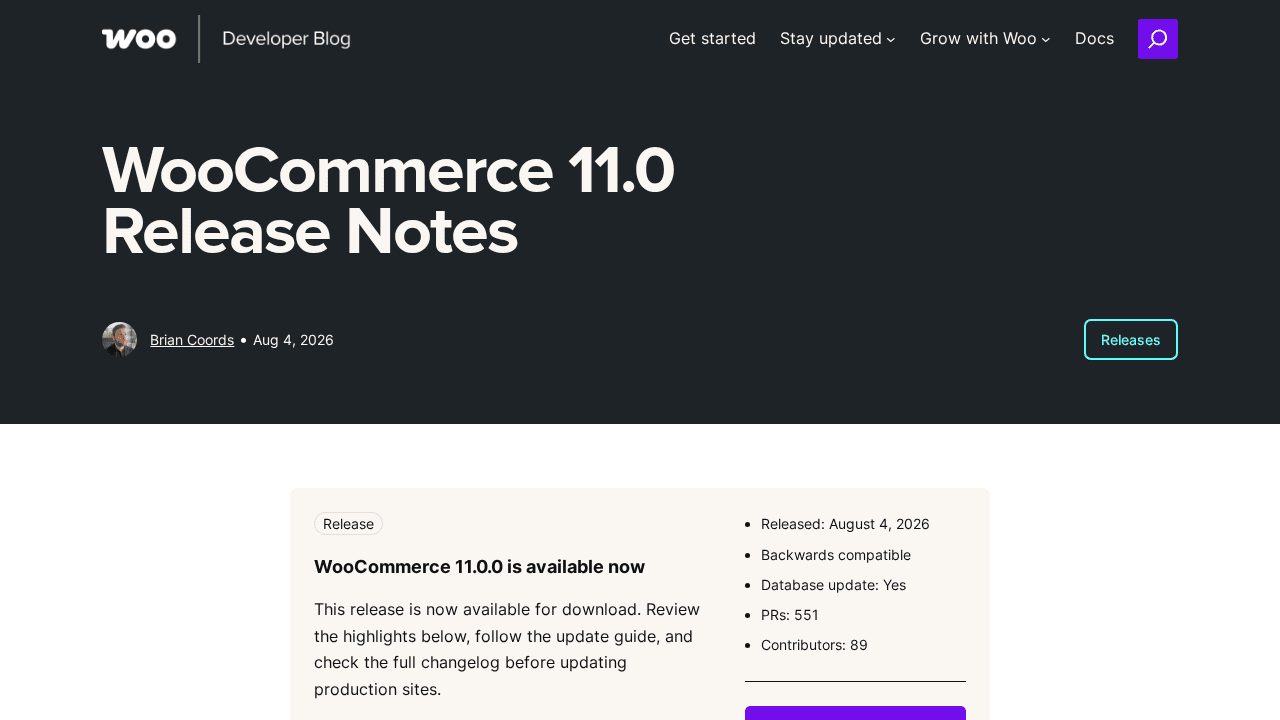
WooCommerce 11.0.0 was released on August 4, 2026, one week after its planned July 28 date, after release candidate testing found a fatal error under specific circumstances in a new performance feature. With 551 pull requests from 89 contributors, WooCommerce calls it one of its largest releases in recent history.
WooCommerce 11.0 includes a database update and keeps the minimum requirements at WordPress 6.9 and PHP 7.4. Its themes are performance for large stores, guest order claiming, more reliable analytics and a cleanup of experimental code.
Customers can claim past guest orders in 11.0
WooCommerce has allowed account creation after checkout since version 9.5. In 11.0, logged in customers can confirm ownership of an email address through a verification step and connect previous guest orders to their account.
Repeat buyers who started as guests. Shoppers who check out as guests and register later often contact support asking where their past orders went. After the update, we walk through the verification flow on staging as a returning guest, check the email it sends matches the store's branding and update the store's help pages so customers know the option exists.
Analytics refunds, import retries and visitor IDs in 11.0
- The v3 sales report includes a
refundsvalue in each date bucket for more accurate net sales; v1 and v2 are unchanged - Failed historical analytics imports are surfaced in the admin with a retry option, and integrations can use
GET /wc-analytics/imports/statusandPOST /wc-analytics/imports/retry-failed - Analytics events require a stable visitor ID to avoid inflated session counts from transient or bot clients
Reports that finally match the books. Refunds in sales reports change the figures clients compare against their accounting software. We point out the change to clients before the update and, if a custom report reads the v3 sales endpoint, adjust it so net sales are not counted twice.
Failed orders now return reduced stock
Before 11.0, WooCommerce restored stock when an order moved to cancelled or pending, but not when it moved to failed. Starting in 11.0, an order that reduced stock and then moves to failed has its stock restored automatically, which mainly affects asynchronous payment methods that place an order on hold before a payment is rejected. Stores that use the failed status for other purposes, such as failed deliveries, can remove the new hook.
Inventory and payment workflows. Stores with bank transfers or delayed card payments will see stock come back when those orders fail, which is usually what they want. For stores that repurpose the failed status, we review the order workflow with the client and, where stock must stay reduced, add the documented code to keep the old behavior.
Product object caching for new stores and other 11.0 performance work
WooCommerce 11.0 enables product object caching by default for new stores. WooCommerce reports variable products loading roughly 9 to 12% faster on product pages and bundle products processing 6 to 12% faster at checkout. Existing stores can opt in, and WooCommerce plans to turn it on for them in a future release. The release also optimizes HPOS orders screen queries and limits and de-duplicates Store API collection data count requests.
Opting existing stores in. We do not switch product object caching on for an established store without testing. On staging, we compare prices, stock levels and cart totals for simple, variable and bundled products with the cache on, especially where dynamic pricing or membership discount extensions are installed.
Product Editor beta removal and other 11.0 compatibility changes
- The block based Product Editor beta is removed, including its package, feature flag and routes; products and product data remain in place
- Action Scheduler is upgraded to version 4.0.0
- Checkout Recovery continues as a beta, with manual recovery emails and one click unsubscribe
- New
woocommerce_validate_phoneandwoocommerce_format_phone_numberhooks support local phone formats ReserveStock::reserve_stock_for_order()defaults to 60 minutes when no duration is passed- The
product_shipping_classtaxonomy is no longer public
Stores that tried the Product Editor beta. Any store still using the beta Product Editor returns to the classic editor in 11.0. We check client sites for the old feature flag and for extensions that added Product Editor blocks, and confirm product editing still exposes every custom field the store's team relies on.
WooCommerce 11.0 FAQ
Why was WooCommerce 11.0 delayed?
Release candidate testing found a fatal error under specific circumstances in a new performance feature, so WooCommerce prepared a second release candidate and moved the release from July 28 to August 4, 2026.
Will my products disappear with the Product Editor beta removal?
No. WooCommerce says products and product data remain in place; only the experimental editing screen is retired.
Is product object caching on for my existing store?
Not automatically. It is on by default for new stores, and existing stores can opt in.
Planning a move to WooCommerce 11.0? Our support and maintenance plans cover the database update, Action Scheduler and inventory testing and a full checkout run on staging first. Contact us to schedule it.